
One stamp per visit or a minimum spend? How to choose the right rule for your stamp card
Is completing a purchase enough for a stamp, or should customers spend a certain amount? How the rule affects simplicity and profitability, and how to choose.
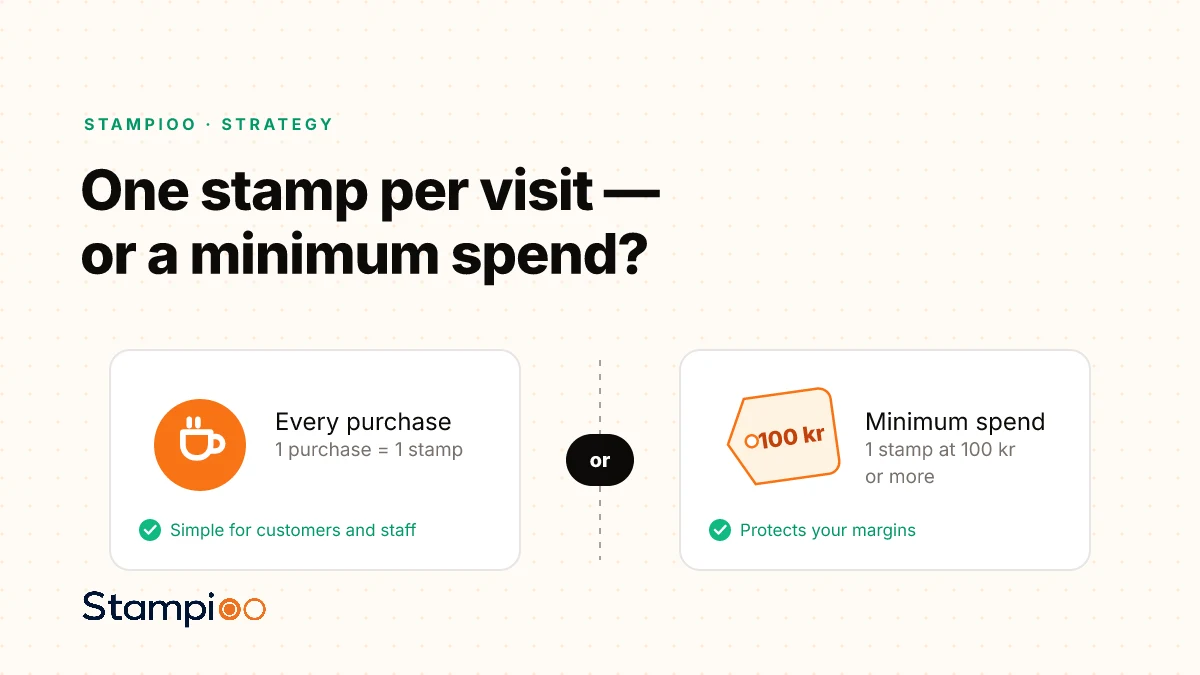
One of the most important questions when creating a stamp card is what customers need to do to earn a stamp. Is completing a purchase enough, or should they need to spend a certain amount?
The right model depends on your business, your product range and the value of the reward. The rule affects both how easy the programme is to use and how profitable it is for your business. It is therefore worth thinking through the setup before launching the card. There are two common models: one stamp with every purchase and one stamp when the customer reaches a minimum spend.
The free reward calculator does the arithmetic for you: enter your average purchase, margin and stamp count and it shows what the reward costs you and the visit lift at which the programme breaks even.
How one stamp per purchase works
The customer completes a purchase and receives a stamp. It is the digital version of a traditional stamp card and requires no calculations from either the customer or your staff.
The main advantage is simplicity. Customers immediately understand how the card works and staff can explain it in a single sentence. If a customer needs three more stamps to earn a reward, that simply means three more purchases. This model also rewards the behaviour many businesses want to encourage: repeat visits. Customers who return more often create more opportunities for sales and have a clear reason to choose your business again.
The disadvantage appears when purchase values vary significantly. A customer making a very small purchase can receive the same stamp as someone spending considerably more. If your business sells both inexpensive items and more expensive meals, products or services, this can affect the profitability of the programme.
How a minimum spend works
With this model, you set a spending threshold that customers must reach to earn a stamp. For example, customers could receive one stamp when they spend at least 100 SEK. The card works in the same way as before, but the stamp is only added when the purchase reaches the required amount.
The advantage is that it protects your margins and reduces the risk of customers collecting stamps through very small purchases. The threshold may also encourage customers to add something extra to their purchase to reach the required amount.
The disadvantage is that the programme becomes slightly more complicated. Staff need to check the purchase amount before adding the stamp and customers need to understand the threshold. It can also create a disappointing experience when someone spends just below the required amount and does not receive a stamp.
Which rule is right for your business?
Give one stamp with every purchase if:
- Customers usually buy products or services at similar prices.
- There is little difference between your lowest priced item and your average purchase.
- You want a programme that is easy for both customers and staff.
- Your main goal is to increase repeat visits.
This often works well for cafés, bakeries, lunch restaurants, barbershops, nail salons and car washes. Set a minimum spend if:
- Your product range includes both inexpensive and considerably more expensive items.
- The reward has a high value compared with a small purchase.
- You want to encourage customers to increase the value of their purchase.
- You have a clear understanding of your average purchase value.
Work backwards from the reward
A simple way to evaluate the setup is to start with the reward. If customers receive a coffee worth 45 SEK after collecting ten stamps, the retail value of the reward equals 4.50 SEK per stamp. Compare that with the margin on a typical purchase and the actual cost of providing the reward.
If a normal purchase provides a healthy margin, you may not need a spending threshold. A threshold is most useful when small purchases are common or when the reward is expensive to provide.
Remember that a digital stamp card provides more value than the stamps alone. You can build a customer list, understand how often customers return and send relevant messages directly to their phones. That value remains regardless of which rule you choose.
Combine a simple rule with campaigns
The basic rule does not need to control the entire programme. You can start with a simple model and use temporary campaigns to influence customer behaviour. Examples:
- Offer double stamps during quieter days.
- Give an extra stamp to customers who try a new product or menu.
- Send a birthday message with a personal reward.
- Offer a bonus stamp during a special weekend campaign.
With a digital stamp card in Apple Wallet or Google Wallet, offers can be sent as push notifications directly to the card on the customer's phone. There is no need to print new cards or send physical mail.
Our recommendation
If prices vary significantly across your product range, set a minimum spend or connect the stamp to a specific product. This prevents a very small purchase from earning the same stamp as a considerably larger one.
If your products or services are priced at a similar level, keep the programme simple and give one stamp with every purchase, regardless of what the customer chooses. It is easier for customers to understand and simpler for staff to manage.
Choose a clear reward and let customers collect between eight and ten stamps. Then place a scannable code in a visible location at the checkout. Simplicity is an important part of the experience. Customers should understand the programme immediately and staff should be able to use it without extensive training. This increases the chances that the stamp card will actually be used and lead to more repeat visits. For the full launch checklist, see our step-by-step guide to creating a loyalty programme.
Launch your loyalty programme this week.
Start with a 30-day free trial.
Create my card for freeSet up in minutes · Cancel anytime