
Loyalty app, Wallet card or paper card: which do customers choose?
Your own app, a card in Apple Wallet or Google Wallet, or an ordinary paper card? How they differ in hassle, cost and the chance to reach customers again, and when your own app actually pays off.
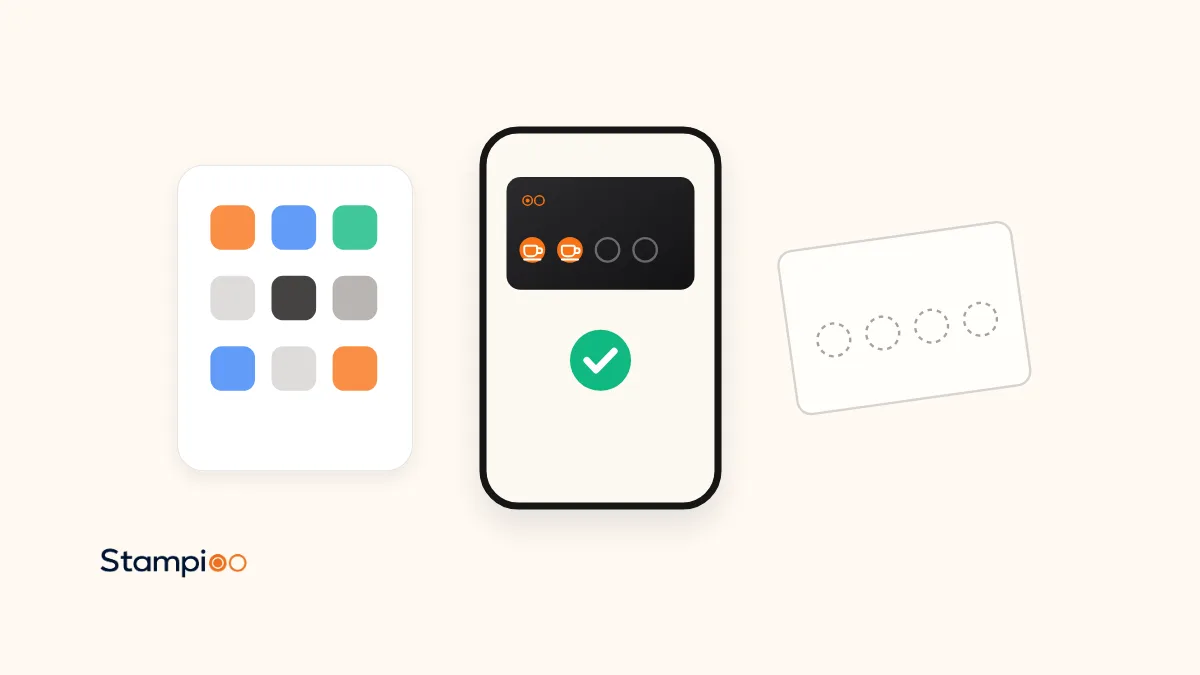
For most small businesses, a loyalty card in Apple Wallet or Google Wallet is the option that asks the least of customers and still lets you reach them again. A paper card is the easiest to start with but gives you no contact with the customer afterwards. Your own app mainly suits larger chains that want ordering or payment on the phone anyway and have a budget for development.
Here we compare the three on what matters day to day: how much hassle it is to join, what it costs, whether you can reach the customer again and what the customer actually has to agree to.
In short
- Paper card: nothing to install, but easy to lose, easy to cheat and no way back to the customer.
- Wallet card: the customer scans a QR code and saves the card, no app needed, and you can send campaigns to the lock screen.
- Your own app: can do the most, but customers have to download it, and you pay for development, store fees and maintenance.
- Your own app makes sense for chains that also want to offer ordering, payment or booking in the app.
Three ways to reward regulars
The paper card is the classic cardboard stamp card or punch card. The Wallet card is the same idea on the phone: what many people call a digital stamp card, we call a loyalty card, and it is saved in Apple Wallet or Google Wallet. Your own app is an app with your name in the App Store and Google Play, where the loyalty programme is one part of the app.
| Aspect | Paper card | Wallet card | Your own app |
|---|---|---|---|
| Joining | The customer is handed a card | Scan a QR code, fill in a short form, save the card | Download the app, create an account, allow notifications |
| Your cost | Printing and reprinting | A monthly fee, with Stampioo from €29 excl. VAT | Development, store fees and ongoing maintenance |
| Reaching customers again | No | Campaigns and reminders on the lock screen | Push notifications, if the customer allows them |
| Do you know who the customer is? | No | Yes, with the details you have chosen to ask for | Yes, through the customer account |
| Can get lost | Easily | It is on the phone | It is on the phone, as long as the app stays installed |
The hassle of joining matters most
A loyalty programme only works if customers actually join, and most of them decide at the till. Picture a customer holding their coffee with three people behind them in the queue. Every extra step is a chance to think “maybe next time”.
With your own app, the customer has to find the app, download it, open it, create an account and often confirm their email address. With a Wallet card, the customer scans a QR code, fills in a short form and taps Add. The wallet is already on the phone, so there is nothing to install and no password to remember.
The paper card wins in the moment itself, because the customer just takes a card. The problem comes later: the card is left at home, goes through the wash or sits in a coat pocket with three stamps on it.
What it costs
Paper cards cost printing and reprinting. To test at no cost, you can make your own cards with our printable loyalty card maker, which gives you a sheet of ten cards to print and cut out.
A Wallet card costs a monthly fee. With Stampioo it starts at €29 a month excl. VAT, with unlimited customers and scans, and you can try it free for 30 days with no commitment. See the pricing for every plan.
Your own app comes with several costs. Development varies so much between agencies and features that the only honest advice is to get quotes. On top of that, Apple's developer programme costs 99 USD a year, and Google Play charges a one-off fee of 25 USD for a developer account. Then the app needs updating whenever iOS and Android change, and someone has to answer when customers cannot get into their accounts.
Reach: can you get back in touch?
This is the big difference from paper. With a paper card you do not know who the customer is, and you cannot remind them to come back.
A Wallet card sends automatic notifications when the customer gets a stamp or a reward. You can also turn on reminders that show the card on the lock screen when the customer is nearby, and send campaigns with offers and news at no cost per text message. Campaigns reach the customers who have saved the card and allowed notifications from Wallet. With Stampioo, Pro includes 10 campaigns a month and Enterprise unlimited, while Starter has no campaigns.
Your own app can send push notifications, but only to people who have installed it and said yes to notifications. Apple requires apps to ask for permission before sending notifications, and on Android 13 and later, notifications are switched off for newly installed apps until the customer gives permission. So your reach is the people who have both downloaded the app and said yes.
No route is free of limits. Google, for example, allows at most three messages with a notification per Wallet card per 24 hours. For a café or a salon that is plenty, because one good offer a week does more good than three a day.
What the customer actually has to agree to
Think about what you are asking of the customer. A paper card asks nothing. A Wallet card asks for a short form and a spot in the wallet next to their payment cards. An app asks for a download, storage space, an account and a place among the apps on the home screen, and on top of that it has to feel worth keeping.
For a place the customer visits once a week, the question is simple: is a free coffee every tenth visit worth a whole app? For a chain where customers also order, pay and track their points in the app, the answer may be yes. The best answer comes from your own customers. Put up the QR code by the till during a trial period and see how many join.
When your own app is the right choice
Your own app is not wrong. It is just expensive for what it has to do. It works best when the loyalty programme is a small part of something bigger:
- You run a chain with many locations and customers who come often.
- You want customers to be able to order ahead, pay or book on their phone.
- You want membership tiers, personal offers and your own customer account in the same service.
- You have a budget for development, maintenance and the marketing it takes to get customers to download the app.
If you run a café, a salon or a restaurant with one or a few locations, a Wallet card is usually a better first step. You get stamps, rewards, a customer list and a route to the customer's lock screen, without building an app.
Try a loyalty card in Wallet
Create your loyalty programme, put up the QR code by the till and see how customers respond. No card details needed.
Try free for 30 daysFrequently asked questions
Is your own app better than a Wallet card?
Not for most small businesses. An app can do more, such as ordering and payment, but customers have to download it and you pay for development and maintenance. A Wallet card gives you stamps, rewards and campaigns with no download.
How much does it cost to have your own app in the App Store and Google Play?
Development itself varies a lot, so get quotes. On top of that, Apple's developer programme costs 99 USD a year and Google Play charges a one-off fee of 25 USD, according to Apple's and Google's own pages.
Can I send push notifications without my own app?
Yes. With a loyalty card in Apple Wallet or Google Wallet, you can send campaigns to cardholders' lock screens. With Stampioo, Pro includes 10 campaigns a month and Enterprise unlimited.
Should I stop using paper cards altogether?
You do not have to. You can offer the digital card to every new customer and keep a few paper cards as a backup for customers whose phone cannot save a Wallet card.
If you want to move on from paper, read our comparison of digital and paper stamp cards. If you are choosing a service, our comparison of digital loyalty card software goes through several options.
Fees and rules for apps and notifications according to Apple's and Google's own pages, checked 2 November 2026.
Keep reading
Launch your loyalty programme this week.
Start with a 30-day free trial.
Create my card for freeSet up in minutes · Cancel anytime