
Stamp card template: free to print (PDF and PNG)
A stamp card template you can finish in a minute: your name, your reward and your colours, ten cards per sheet. Here is what a good paper card needs, templates for eight types of business and how to stop fake stamps.
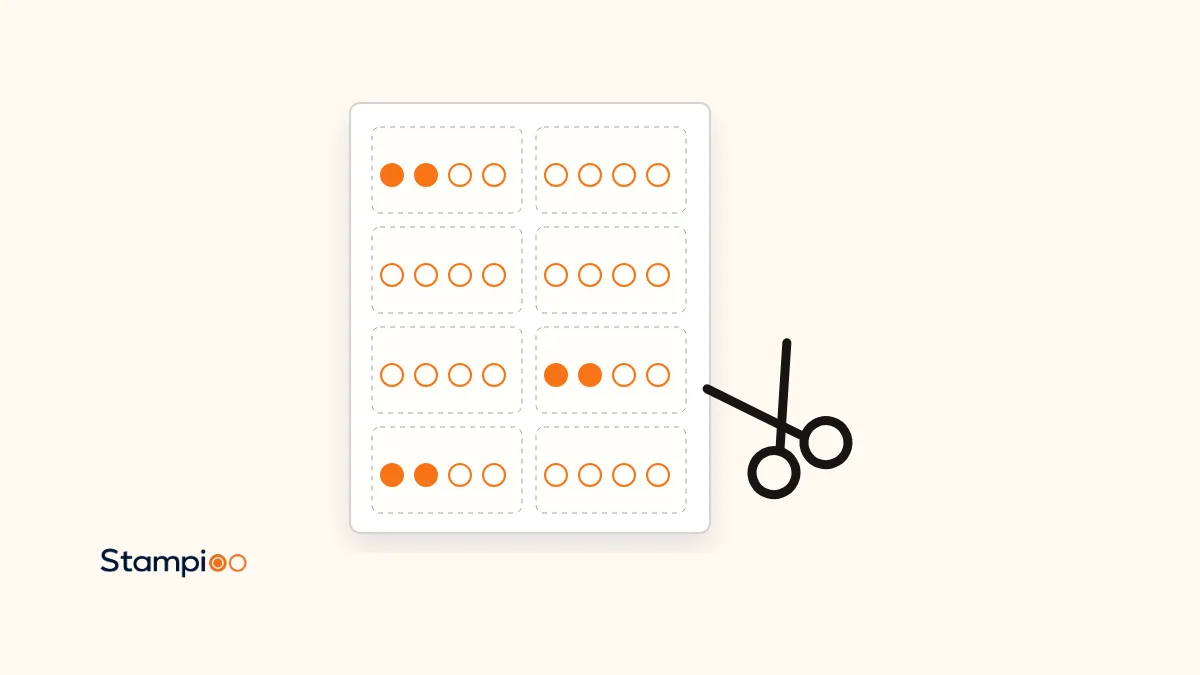
A good stamp card template gives you a business-card-sized card, 85 × 55 mm, with your business name, 6–10 boxes for stamps, a one-sentence reward and the terms on the back. With Stampioo's free printable loyalty card maker you make the card in your browser, print ten cards per A4 sheet, and save them as a PDF from the print dialog or download them as PNG and SVG.
What many people call a stamp card or punch card, we call a loyalty card: a card that collects stamps towards a reward. This guide is about the paper card: what it should include, how to print and cut it, and how to make cheating harder. At the end there is an honest section on when paper is enough and when it is time to move to the phone.
In short
- Size: 85 × 55 mm, like a business card, so it fits in a wallet.
- Stamps: enough for the card to fill up within a few months, usually 8–10 for coffee and bread and 5–6 for hairdressers.
- Reward: one specific thing in one sentence, such as “10 stamps get you a coffee on the house”.
- Cheating: stamp with your own rubber stamp, never a pen, and print the terms on the back.
- Free template: ten cards per A4 sheet, a PDF from the print dialog, PNG and SVG for the printer.
What a good stamp card template includes
The size: 85 × 55 mm
A stamp card belongs in the card slot of a wallet, next to the bank card. Otherwise it ends up in a coat pocket and disappears. That is why business card size is the standard: 85 × 55 mm in Europe. That leaves room for your name, logo, a line about the reward and up to about ten boxes big enough for a stamp. You can fit more, but then the boxes shrink and the stamps start to spill over the edges.
The number of stamps
Start with how often a typical regular comes in, not with how generous you want to be. A card that takes more than a year to fill gets forgotten. Say your regular comes once a week: eight stamps then take two months to collect, which feels within reach. If the customer comes every six weeks, as at many hairdressers, eight stamps take almost a year. Whether a stamp should require a minimum spend is a separate decision, and we cover it in the guide to one stamp per visit or a minimum spend.
The reward in one sentence
Word the reward so it cannot be misread. “Every 8th coffee free” sounds clear, but is it the eighth or the ninth cup that is free? “8 stamps get you a coffee on the house” leaves no doubt. Say what is included, too, for example “today's lunch” rather than “a meal”. To find out what the reward costs you, work it out with the reward calculator.
The terms on the back
The template makes the front. The back is the place for the rules, and they do not need to be long. Three or four lines will do: what earns a stamp, that the reward cannot be exchanged for cash, whether the card is personal and whether it has an expiry date. If you order the cards from a printer, ask for double-sided printing with the terms on the back. If you print at home, the terms can go on a sign by the till instead.
Templates for eight types of business
A café and a hair salon do not need the same card. How often customers visit decides the number of stamps, and your margin decides the reward. Each template below comes with a name, a reward and a guide for that particular business already filled in. The figures in the table are suggestions to start from, not rules.
| Business | Stamps | Example reward | A rule that usually works |
|---|---|---|---|
| Café | 8–10 | A coffee on the house | One stamp per coffee drink |
| Hair salon | 5–6 | A hair treatment or gloss | One stamp per visit |
| Barber | 8–10 | A haircut or beard trim | One stamp per haircut |
| Restaurant | 10 | Today's lunch on the house | One stamp per paid lunch |
| Bakery | 8–10 | A loaf from today's range | One stamp per purchase |
| Shop | 5–8 | A discount on the next purchase | One stamp per set amount spent, for example €20 |
| Beauty salon | 6 | A brow tint or face mask | One stamp per treatment above a set amount |
| Nail salon | 8–10 | Nail art on the house | One stamp per visit |
- Stamp card for cafés: a coffee card for regulars who come in several times a week.
- Stamp card for hair salons: few stamps for infrequent visits, with room for the next appointment.
- Stamp card for barbers: more stamps for short styles that are cut every two to four weeks.
- Stamp card for restaurants: a lunch card for the guests who eat with you every week.
- Stamp card for bakeries: a bread card with a reward you are baking anyway.
- Stamp card for shops: stamps that follow the amount spent.
- Stamp card for beauty salons: one clear rule for lots of different treatments.
- Stamp card for nail salons: a stamp per infill, and cards kept at the station.
How to print and cut the cards
Fill in the card
Type your business name and the reward, then choose the number of stamps, a stamp icon and your colours. Upload your logo if you have one.
Choose the size and paper
Choose 85 × 55 mm and A4, or 3.5 × 2 inches and US Letter if you have perforated Avery 5371 sheets. Load the thickest paper your printer can handle, ideally matt so the ink takes well.
Print at 100%
Choose 100% scale and no margins in the print dialog. If the printer fits the sheet to the page, the cards come out too small. For a PDF, choose Save as PDF instead of a printer.
Cut along the crop marks
Use a ruler and a craft knife or a paper trimmer and cut along the marks in the margin. Cut one row at a time, not the whole sheet at once.
Or let a printer do it
If you are handing out hundreds of cards, download the PNG or SVG and ask the printer for matt card stock and double-sided printing with the terms on the back.
How to stop fake stamps
A paper card can always be cheated to some degree. The aim is to make it awkward enough that nobody bothers. These help the most:
- Use your own rubber stamp, ideally with your logo or initials. Anyone can draw a cross with a pen.
- Choose an unusual ink colour and keep the stamp behind the counter.
- Ask customers to write their name on the card, so it is not passed around between friends as easily.
- Sign or date the last stamp before you hand over the reward.
- State in the terms that it is one card per customer and that stamps are only given with a purchase.
- In salons where clients come in on a schedule, you can keep the cards in a box by the till.
Paper or digital: an honest answer
A paper card is a good choice when you want to start today, test a reward or only have a handful of regulars. It costs next to nothing and everyone understands it. The downsides show over time: cards are left at home, get worn or go missing, stamps can be faked, and you do not know who your regulars are or how to reach them.
A digital loyalty card in Apple Wallet or Google Wallet stays in the customer's phone, updates when you add a stamp and can only be stamped by your staff. The customer needs no app, they just scan a QR code. You can remind customers when they walk past and, depending on your plan, send offers to their lock screen. It costs a monthly fee, from €29 a month excluding VAT. We compare the pros and cons in detail in digital stamp card or paper card.
Make your stamp card in a minute
Your name, your reward and your colours. Ten cards per sheet, free and with no account.
Open the templateFrequently asked questions
Is the stamp card template free?
Yes. You design the card in your browser with no account and no email address, then print or download it for free. The only branding is a small line about stampioo.com in the margin of the print sheet, outside the cutting lines.
Is the template available as a PDF or Word file?
You get a PDF by choosing Save as PDF in the print dialog. There is no Word file, but you can paste the PNG image into Word, and the SVG file opens and can be edited in most design programs.
How many stamps should a stamp card have?
Work backwards from how often customers visit: the card should fill up within a few months, a year at most. That usually means 8–10 for coffee, bread and lunch, and 5–6 for hairdressers and other businesses with less frequent visits.
What size is a stamp card?
The most common size is a business card, 85 × 55 mm, which fits the card slot in a wallet. The template can also make 3.5 × 2 inch cards for perforated Avery 5371 sheets on US Letter.
Is there a template for prepaid passes?
A prepaid pass is not the same as a stamp card: the customer pays upfront for, say, ten lunches and one is ticked off at each visit. This template makes stamp cards, where the customer pays as usual and gets a reward when the card is full. If you sell prepaid passes, that money is a payment in advance, so check with your accountant how to record it.
To make the card look better before you print, read how to design a loyalty card customers want. And when the paper cards start running out, you can try a digital loyalty card free for 30 days, with no card details.
Keep reading
Launch your loyalty programme this week.
Start with a 30-day free trial.
Create my card for freeSet up in minutes · Cancel anytime